Sunday, January 5, 2020

2020

2019 was a great year. I moved to a new city, finished school, started a new job, and shared many special moments with my loved ones. Speaking of love, at the end of 2019, I rediscovered that too. While last year would be hard to top, I do have a few goals that I want to achieve:

1. Create a personal website and move this blog to it (also blog every week)

2. Run 10k under 40 minutes

3. Visit two new countries and visit 3 new cities (in the states)

4. Take a 1 second video everyday and post it at the end of the year.

I wish everyone the best in 2020.

:-)

Saturday, July 6, 2019

Return- Thank You.

I recently returned from a trip back home to Toronto. I put on a gown, walked across a stage, got a few pieces of paper, and sit back down. When you describe what happened in sentences like that it seems a bit strange that it was one of the most emotional times in my life. When the announcer said my name, the french version of my name to be more specific,  I couldn't even think straight. I was just overcome with so much emotion over what the last 5+ years meant to me, to my friends, to my family.

The only words that came to mind were Thank You! There is a song by Apani-B and Nujabes (a Japanese DJ) that seems fitting for this reflection.  It's also cool because a lot of significant people in my life went to japan this year as well.

So after all the years of gains, losses, sacrifices, gifts, pain, promises, sorrow, laughter, dispair, hope. Iˋm left with two simple words: Thank You.


Saturday, February 9, 2019

Showing Gratitude

Next week in addition to preparing my thesis defense, I am going to be writing the acknowledgement section of my thesis. Looking back on this journey, I realized that there are so many people to thank. If I were to include everyone it would be almost as long as the document itself. It has also been cool to look back at things. Every time I look back I tend to do it through rose coloured glasses. There are no longer term experiences (even terrible relationships, trips, or jobs) that don't eventually bring a smile to my face. Even the tough times I went through when losing vision in my right eye, I view them now as challenges that were not just present but integral.  Maybe I am the only one with this disposition, but I doubt it. Anyway, when reflecting on this, one of my friends gave me some advice on how to write my acknowledgements. They said to only thank significant contributing members and to professionally acknowledge personal relationships that are not family.

To me this seems weird. I was thankful for the advice but I respectfully have to disagree (sorry homie - I know we go back and you are going to be done soon, but still). I disagree for a few reasons.

First, no one you actually acknowledge will read your thesis outside of your committee (maybe) - and anyone directly involved in the projects. I read the the acknowledgement sections of only two people (a student that I was mentoring this year), and my old supervisor. I skipped past the acknowledgements and most of the parts of any other thesis I accidentally thought was a paper.

Second, a thesis, just like any long term project, is a single snapshot in a long time line. In this way it is kind of like a old yearbook, scrapbook, or photo. The acknowledgement section represents how you feel and who means a lot to you at the moment. In this way- it is better too just write and thank and show gratitude to those in your heart  in the moment. Those sentimental shout outs may evoke some stomach twists if the people you shout out break your heart, but when you revisit those words of gratitude it will likely serve as an honest reminder of the good times that once were. Don't think too much about it.


Lastly, it is the one part of your thesis where you don't have to be formal so why do it. I would say be true- thank everyone, thanks the cats in marseille (shout out anahid), thank the person reading it, shout out the sidewalks from keeping you off the streets. Be as thankful and as honest as you can- leave the formalities for the oscars and political speeches.

Wednesday, February 6, 2019

The Meetup

So I head out of my apartment into the hallway. Hmmm, the lights still don't work and half of the hallway to the exit door is under construction. It's got a damp and humid smell, even though it seems to be hot outside. I open up the door, and the sure enough the anticipated hot sun hits me directly on my face. To my surprise, clement was there already, accompanied by his red vespa.

"Hey man, what you sayin?" - Clem
"Nothing much fam, you been waiting long?" - me
"Don't even worry bout that, just grab this helmet and come with me, we gonna hit up the Macrina"- Clem
"Whoooaa this must be some scam you thought of homie... we eating in Bell Town?" - me
"Dawg, just grab the helmet, mans are hungry"- Clem

So we zip down from Fremont to Bell Town for breakfast. It is actually a pretty nice ride. If you're not on the back of a vespa. I think that was peak hipster level, plus hardly anyone in Seattle uses a Vespa so we got a lot of attention.

"We here"- Clem
"Damn, you got a reservation and everything? This must be really important" -me
"Aiight homie, let's eat" - Clem


We both get off the Vespa and walk into the Macrina Bakery. The place looks a lot more live than I remember. The smells of baked goods, bacon, eggs, and bread fill the air. We are greeted by this extremely attractive hostess who escorts us to our seat. After some playful chitchat she leaves us the menu. Little did I know this little get together was gonna turn into one of the most hectic weeks of my life. It all started when Clem asked:

"Man, you remember when you were a kid?"


Tuesday, February 5, 2019

You play different when you are keeping score.

The last week has been hectic, and I have slipped a little bit, I did keep writing but I found it much easier to reach for my pen and notebook than to write on the blog. However, I still feel like I am cheating on my New Year's resolution so I wanted to get back on it. So this week - I want to get back on it and make time to put the words from the various scraps of paper back onto the web (also this way I can move and refine what I wrote on paper to the big pages).

The first of which was a piece I wrote about keeping score: 

You play differently when you are keeping score. I used to hate this saying because it never offered a direction. You don't necessarily play better when you are keeping score. Usually games are also more fun when you're not. Over the last week of my own writing (aka slacking), I do realize however that not posting my thoughts in a way was not keeping score. My most productive times in any endeavour happened when I had a visual scoreboard. What is even more effective is having a scoreboard focused on meta-skills, like focused on thing I can do everyday or in the moment. As a Ph.D student , a scoreboard tracking the number of publications who get isn't gonna be that effective at keeping you on task- but I scoreboard on how much you wrote everyday will be. Spoiler alert is that my most effective scoreboards were ones focused on the pomodoro method. 


While it was fun to write on papers and when my laptop ran out of battery - it did feel different. So anyways, I am coming back online. 


Sunday, January 27, 2019

Recovery

One thing is true with any goal you set. There will be setbacks. I experienced a small setback this week as work and life picked up and I couldn't escape to my computer to write a couple sentences. However, I am back at it, and I actually don't feel bad about it. My goal now is beat my last streak of days where I was able to write everyday. It is being able to better schedule myself and plan the content out ahead of time. Thinking about the recovery, and the potential I have to continue where I left off quickly alleviated any disappointment I had by not being able to put my thoughts into text this time around.

Some things I look forward to writing about are:

1. Recovery (check)

2. Progress using the pomodoro method

3. Fmri Analysis

4. Acknowledgements for my thesis 

5. Getting my own place in houston

6. Continuing the fictional story I started writing a couple weeks back

7. The boondocks comic strip


Let the writing continue.

Friday, January 25, 2019

The pomodoro technique

The pomodoro technique is a study technique developed by an italian engineer Francesco Cirillo in the 80s, but I'm pretty sure that the basis for the technique has been around for a long time. Basically the concept is that you set a timer, and work undistracted for the duration of that timer. This is followed by a short break, then another work session. You work on a task for four work sessions before taking a long break. Usually when beginning, I start with 15 minutes work sessions and 3 minute short breaks. I also write down questions and distractions and deal with them later. As I get better I stretch the sessions out to 25 minutes.

At various times in my life I have tried to use this technique and to varying degrees of success it has worked. For example it works well for thesis writing, paper writing, studying for tests (combined with some other methods like reviewing what you learned in the worm sessions) and data analysis. The technique does not work so well for me when reading, coding ( it's hard to break the flow) or learning new methods.

The hardest parts about implmenting the technique are:
1) remaining undistracted
2) sticking to the short break times


This brings me to my challenge for the upcoming week. I want to be able to carve out 12 pomodoro sessions of 20 minutes per day and stick with it!!

Wednesday, January 23, 2019

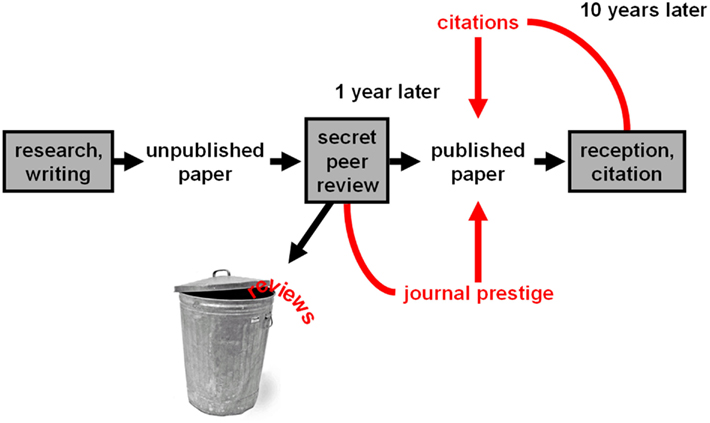
Peer-reviewed journal articles are the perfect business


Think about it. If you own a peer-reviewed journal I want to be you. If you explain the peer-review system to anyone outside of academia it doesn't make sense. In fact, it makes us look like suckers. Not just suckers but unjust pretentious suckers. In my ends we have a word for this, but I want to maintain positivity.

Here is what I mean, an overview: Scientist conduct research, put many hours into doing this research, piloting experiments, conducting field work etc... At the end, sometimes after years and many person-hours of work, an article reporting the results of the experiments is written and submitted to a scientific journal. The work is then reviewed by others in the field to ensure rigour and quality. The reviewers (who also work for free) provide anonymous comments to the authors (which is another huge issue- but for another time). If the reviewers think the article has merit, then revisions are completed and eventually the manuscript reaches a point where it can be accepted for publication (in the best of cases).

What happens next is what is funny. The journal, without supporting the work or the people who did the work, then publishes the work along and obtains copyright on the article. They then charge exorbitant subscription fees to institutions for access to the work. At this point only a few select people have access to the completed work in its final form. This is Genius! Think about it - reviewers, authors, and sometimes editors are not supported by the journal. While there are some costs associated with post-productions, delivery, and the maintenance of online submission and revision systems, I am willing to bet publishers still make a healthy profit. This is messed up.

What's even more messed up is that, in some cases researchers and students are largely supported by public funds- that means my work was paid for by taxpayers (through the school and scholarships). Therefore when I submit to a journal- the people who supported the work now have to pay again to see it. Furthermore, they want embargos on anything that is published containing the same work (like a thesis). And I almost got one! I've made up my mind however- forget your embargo son!!- I'mma let the people see what they paid for (don't worry I did some technical stuff so I'm protected- shout out to my law crew, and get at me).

Tuesday, January 22, 2019

New project: Life as a playlist- 2018

Okay, so our auditory and memory systems may be linked to memory. Although this might be a logical fallacy (see previous post) it is fun to think of your life in timelines. But what if you think of your life in terms of a playlist. When I listen to songs, I tend to remember situations that surrounded me when I was listening to that song. You put these songs together and you have a playlist of emotions that defines a time in your life. If you have access to a spotify/ streaming music service and wondered what my 2018 looked like - well here it is:


1. Know no better- major lazer

2. Run Up - major lazer

3. Rolex - Ayo and Teo

4. Thinking about you - Calvin Harris

5. Story of OJ - JayZ

6. To U - Skrillex and Diplo

7. Miss You - Tory Lanez

8. Slide- Calvin Harris

9. Angels - Chance the Rapper

10. Gods Plan - Drake

11. Congratulations - Post Malone

12. Freaky- Friday - lil dicky

13. Playin wit me - Kyle and Kehlani

14. Wrote my way out - Nas

15. I see fire - Ed Sheeran

16. No problems  - Chance the rapper

17. Do what I want - Lil Uzi Vert

18. Particula - major lazer

19. Lost- Major Lazer

20. Ikuyo- Kyle

21. Brocolli - DRAM

22. I spy - Kyle

23. Mixtape- Chance the rapper

24. In my feelings - Drake

25. Good life- Kanye West

26. Sunflower - Post Malone


Monday, January 21, 2019

Logical Fallacies in Neuroscience (Neuroimaging) Research

So last night I spent time reviewing an article. I previously wrote some code for the analysis of these data. The code was designed to compute average source activities in different regions of interest. Source localization of EEG data involves computing the possible cortical sources of electrical activity seen at EEG electrodes. Source localization tries to solve an inverse problem using different mathematical methods. A great description of sources localization procedures could be found here.


EEG Source localization from one of my thesis studies.

As I made my way through the article, I realized something was off. Only after reading about fmri analysis (and the pitfalls) was I able to actually express what was wrong. So here it is. Many of the arguments we make in neuroimaging research are logical fallacies. The flaws in logic stem from two interconnected but separate ideas. The first idea is forward inference- that is, we induce some change and that change results in the activation of some areas of the brain. The second idea is reverse inference, that is, we see some activity in an area of the brain and based on the pattern of activity we say that a certain behaviour is occurring.


Both forward and reverse inferences are possible, and they can be expressed in relation to on another. The logical fallacy occurs when we take a forward inference from an experiment and then argue for using the evidence we obtained using statements that refer to a reverse inference.  An example of this is:

We found increased activity in the PPC when participants moved toward a visual targets. Increased PPC activity is associated visual processing and thus is  related to the encoding of space in a visual extrinsic reference frame. This activity thus could be related to the encoding of space in a visual reference frame when making movements to visual targets. 

This isn't as bad as some others- maybe because it is based on my work 😉. However, there is still something wrong here the increase in PPC activity was found when moving to targets. This last statement links processes associated with the activation to the behaviour. In isolation, this is an error in logic because there is an assumption that the function associated with the activity is directly linked to the behaviour that caused the activity. Although if you look at the results I chose to present, there is nothing indicating that this is the case.

This argument is just as flawed as saying: Dogs likes ice cream, Marlo likes ice cream. Therefore, Marlo is a dog.


This example was taken from a lecture on fmri data analysis- Principles of fmri analysis 1


Sunday, January 20, 2019

101 ways to a better life: Be Goofy

I just finished reading 101 ways to better life (shout out to Cindy) for the book. I highly recommend reading it, it was insightful and real. The author is humble the poet, a local artist and rapper from Toronto. His style of writing is really cool, and each chapter contains short messages that are designed to boost you up and bring you back to reality. I don't want to spoil much of it, because I do think it is a book all people should check out. Here is the link for buying, and there are a few copies in the library!


The Last Chapter of the book, Humble encourages you to write something, your own way that you would share with the world. First I thought about writing a piece about coming back, about taking hits and then recovering. I started writing it and although it was cool and it has great personal significance, it didn't feel totally like me. Then I felt like writing about the importance of knowing owning up to things, and the lessons I learned about accepting the consequences of your choices. Again, same thing although I felt it, I didn't quite feel it. Last, I thought about the importance of showing gratitude and being there for the people you care about. This piece resulted in me making thinking about all the people I have to apologize to and contact. But again, same thing - I wasn't truly feeling it. After some thought I came up with the piece.


May way to a better life: Be Goofy

We spend so much time suppressing the quirks that make us who we are. This is not cool. I'm here to tell you one of my ways to a better life is to be quirky, embrace all your quirks, all of your quarks, and all of your quacks. A lot of life is serious, and a lot of what we do is serious, I'm not saying it's not good to be professional or serious about the many serious things. I'm saying that very few things are that serious, and most of the serious stuff is only serious because other people who don't give a crap about us make it serious.

I say that when you feel like it, forget the serious stuff and be goofy. You feel like playing tag on campus - do it! Physical activity is good for you! If you feel like convincing your family members to joke around on a guided tour-do it! You will create a lasting memory.  You feel like repeatedly stealing a coat-rack from the next office- do it! You could make a great friend that way (or end up with a coat rack). You feel like incorporating a Drake lyric into your weekly updates - do it! You could help relax a tense meeting mood. You feel like leaving a voicemail that is nothing kanye's newest song- do it! It'll show your homie you care and you're there fore them. You feel like leaving sticky notes on a co-workes desk,  setting a screenshot as a friend's computer background, or doing a random (unsolicited) guest post on your homie's insta- do it. Just because.

Being silly is good for you, I have made many great friends, many great memories, and got a coat-rack just because I wanted to be goofy. Sometimes it was not appreciated, but most of the times it was. Life is pretty short, and it should be fun :-D

Saturday, January 19, 2019

Those moments....

You know the ones. It is those moments where you feel like man this if for real. They happen when things are really good, when things are really bad, when you're in a game, when you're making a change, and when something is quickly coming up, or when it is time to finally come clean. It's like in wolf on wall street when theh finally caught him. It's like when you're planning those events and then the day off happens. I love those moments. They are moments that help you live in the present. To realize everything is right now. You can no longer contemplate the past, and you don't know enough to worry about the future. You realize that what it is is now, what it was doesn't really count, and what it will be you can't predict. The last time I had one of those moments was today... I changed my phone number and realized I'm here now. I'm here. I wish y'all a life filled with those moments.

Friday, January 18, 2019

Journal Reflection: Institutional Culture

The beginning of this week was my orientation for the new job position I just started at a research institute associated with larger hospital. What was cool about this orientation was that they had all types of new hires in one orientation. Our group, which the facilitators said was a big group, included everyone from vascular surgeons to Business development specialists, and everyone in between. The majority of the orientation was focused on teaching us n00bs about the institutional culture. The culture at this institution, as they thought it, is one of respect and service. They demonstrated how it is imperative that employees display this through their behaviours. This theme was constant throughout the presentations, and throughout each exercise we had to do. Examples of these behaviours were saying my pleasure after a thank you, and always guiding a lost person to their destination. While my older colleagues did kind of make fun of the orientation, I noticed that they also performed these behaviours. The funny thing was, all of us new employees had some experience that reflected the values taught in orientation.  It is very telling that many of us were surprised that people actually practice what they preached. But even more so it says something about the institutional culture. Maybe I drank the kool-aid a little too fast, but I feel like I'm glad to be part of it.


Thursday, January 17, 2019

The beginning

It was cold....yet again. I don't know why I bothered to do this cold morning shower challenge in the first place. It must have been some article I read somewhere, maybe Sylvester Stallone did it. I don't know. Anyways I wonder why I even keep it up, it's just me who knows about it, and it's not like I'm good at keeping promises to myself anyway. If that were the case, then I would call my sister every other day like I planned to.  I have to have better dialogue with myself in the morning... 
Damnnn what was that noise. I looked over to my bedroom table and there it was. "Beep beep beep". My alarm was going off finally. I swear anytime I set an alarm, I spend all night trying to anticipate it  waking up every two hours, checking all the time until the alarm actually sounds. I swear this, plus the cold shower, is like some sick self-sadistic torture thing. Again, better self dialogue. As I picked up the phone, the screen flashed with "Incoming call from.. Clement"


"Yo what's man what you sayin" - me 
"Nun man, I'm at your ends" - Clem
"Word, it's early man, and it's saturday" - me 
"Yeah man, early bird get that worm, reach downstairs in like 5" - Clem
"hahahahaha, nice try man - I'mma be down in 20, what we gonna do?" - me 
"Let's eat, then I've got an opportunity that we gotta talk about- breakfast on me" - Clem


Wednesday, January 16, 2019

"That ain't weak, it's the starting point"- Coach


The above video is a very interesting scene in the wire. The filmmakers and story writers captured something so real and the first time I saw it I was astounded. It describes a behaviour that I saw a lot when teaching and volunteering as a tutor. Some students out of fear or shame or sometimes even guilt will try to fail. This behaviour could manifest itself in jokes, acting out, or straight up defiance. It is important to remember that most of the time, these behaviours are a cry for help and that, if you stick with them, these students will eventually come around.

Tuesday, January 15, 2019

New Philosophy: Done is better than Perfect.

Shout out to my boy D-Millz for being my inspiration today.  He put some artwork up in the living room in our apartment conveying this message.  We discussed it many times, and came to the agreement that for larger projects like a talk, a thesis presentation, or even a lecture, getting that first draft done is way more important than making it good the first time. Once you have something done, only then can you fix it.

Even if you realize it's complete trash and have to start again, at least you got to that point and now know that it will be better. Nothing ever has to be perfect, and hardly anything ever is. The world itself moves on a tilted access- but it sure as hell makes that orbit. Multiple iterations is better than aiming for the one perfect draft. Aim to get the reps in!

Strangely, the practice of writing a piece everyday is kind of putting this philosophy into action. I don't necessarily care if what I wrote was the cleanest piece. However, I am not trying to write things that are poor or subpar. I am simply doing my best with the resources I have available each day.  This has caused me to be happy with what I have done, and get the words out on the page. Whatever you gotta do, get it done.

Monday, January 14, 2019

Deep Work: Book Review

I've spent a surprising amount of time of last year reading about ways to be productive (I had no internet in my apartment so books were my past-time). These books snuck up on me, and while some of the material was useful, I did find their advice and suggestions repetitive and most times totally ignorant of context. This brings me to one book in particular Deep Work.

Deep Work was a well-written and overall okay read. It was written by Cal Newport, a professor in computer science at Georgia Tech.  I am a HUGE fan of his blog: Study Hacks, and his writing style in general. We share some of the same struggles (dealing with academia) and some practices (I independently quite social media as well, and spent the past year living without internet at home). Given the our similarities and my general respect for what he has accomplished as a person and an academic, I was surprised that I did not at all find Deep Work that compelling. If asked, I would still recommend it as maybe a sporadic read, but I would not say it is a must-read or game- changing book. I will attempt to briefly explain why with this review.

The first part of the book makes the argument that Deep Work is important- he goes through a bunch of anecdotes about great thinkers and how they achieved many of their notable accomplishments through deep work. Newport then argues that working deeply is a useful skill that must be developed in knowledge workers. The first part of the book is well researched, and contains nice tidbits of insightful information.

The second part of the book is where, in my opinion, it falls apart. Newport details his four rules for deep work. They are:
#1: Work Deeply 
#2: Embrace Boredom
#3: Quit Social Media
#4: Drain the Shallows

To me what he describes here borders on preaching. Worse is that the evidence and behaviours prescribed are better described in other books and media. For example, the idea behind the neurological basis for Deep Work is way better described by Barbara Oakley in the learning how to learn course on coursera. Furthermore, some of Newport's ideas are also devoid of context, which makes them less applicable to audiences who don't enjoy too much leisure time or are not super well off financially. Also, the overall message that a more  productive life is the best type of life, and that grand accomplishments and acclaim are what we should strive for is a bit shaky. Newport addresses this in the conclusion to some extent but does not tell the reader much about the limitations and caveats of his methods and rules. 

In addition to the aforesaid larger gripes, Deep Work also justifies unprofessional academic behaviours such as not responding to professional emails. For me these were just a few things that pushed Deep Work over the deep end. 


Sunday, January 13, 2019

A parable


Once upon a time, there was a student who went to a prestigious institute in a village in China. The student was from a very poor family and could not afford both living expenses and food. He rented a small dark room located on top of a restaurant and only ever ate plain rice everyday. One day, a friend from his village visited him and learned who he lived. His friend could not believe it, and asked him, "are you not sick of eating plain rice everyday?" The student replied "not really, because I have a trick". The student explained that timed his meals so that he ate his rice when the restaurant owner cooked for his customers. The smell of the food cooking below flavoured his plain rice. He explained to his friend, it was like having a different meal time.  The restaurant owner overheard the student's conversation and was furious. He was made at the fact that this student was using his smells for no cost and demanded that the student repay for all the food he has stolen.  The judge in the court was known as the fairest judge in all of China and promised to hear both of their cases. The restaurant owner angrily explained that the student was stealing food from the good people who payed at his restaurant. The student said he was not stealing but only trying to flavour his rice as he could not afford to eat anything else. After hearing their cases, the judge ruled that the student was indeed guilty of stealing. He therefore told the student to take out all of his money in order to repay what he had stole. The poor student emptied all of his money from his pockets,  the amount was so little that it only fit in one hand. As the restaurant owner approached, the judge said "hold on!" He commanded the student to pass the money from one hand to another. The student did and the money made clinking sounds as it passed from one hand to another. And then the judge said "all is repaid". The judge then dismissed the student and the restaurant owner. The owner was confused and demanded an explanation from the judge. The judge explained that the student paid for the smell of the owner's food, with the sound of his money.


Saturday, January 12, 2019

Favourite Book: Around the World in 80 days

Although the answer has changed over the years, when people ask me about my favourite novel, I say Around the world in 80 days by Jules Verne. 

Here is a brief synopsis:

Phileas Fogg, a noble from London wagers his friends that it is possible to circle the world in 80 days given the new train system. The book is set in the late 1800s. Accompanied by his "valet", a frenchman name Jean Passepartout, he embarks on a journey that takes him through Europe (rather uneventfully) before passing through India. In India Phileas Fogg and Passepartout save a woman (Aouda) from a sati before they head off to Hong Kong then separately to Yokohama. Fogg, Passepartout, and Aouda then travel from Yokohama to San Francisco. In America they board the transnational railway but face some troubles including a duel and some Sioux warriors before making their way back to the UK by way of burnt steam boat.  Fogg an company are pursued by a detective, Mr Fix, who wrongfully believes Mr. Fogg is nothing more than a robber. Fogg’s unwavering character, demeanour, and honourable pursuits make for interesting dialogues between every character he encounters. His personality is unlike any I have ever read about, and lends itself well to the novel. Fogg makes a tiny miscalculation, and eventually wins the wager.


A few lessons I took away from this book were: 
 - You have to pay the price to get where you want to go. 
 - People will help you if you remain steadfast in your pursuits
 - In the pursuit of your goals, never forget your duty


Some Key Quotes:

“The unforeseen does not exist”

“A well used minimum suffices for everything”

“Are you a man of heart?” “Sometimes, when I have the time”

“No one heard this safe reflection- no one even acknowledged it’s justice”


Sticking it out

A lot of what we dream of is hard to accomplish, and not worth it. We will likely never be happy once we get that "thing", we only think we will. For me it has been many things ranging from getting into university, to having a scientific publication, to a sub-40 10k, to an Ipad. I have realized that nothing really changes, the attainment of one thing just makes you want the next thing. That is us, it is our nature, it is our society, whatever it is, it is. There is an inherent problem with this, and tons written about it.  But what I want to write about today is the benefits of sticking to it. The problem is not really in what we want- it is in how fast we want it. We want things conveniently and quickly. Most things that are worth having, do not come easy, we often have to stick with it. While tales of perseverance make great stories they are not great in the moment. Imagine bombing that 44th interview, or sending out that 200th application. Its tough- but we owe it to ourselves to stick with it. Trust and enjoy the process because the end will likely not make you happy anyways. This is kind of a gift now don't you think?!